Low-Slope and Commercial Roofs: What Property Managers Should Watch For
On a flat roof, the leak is rarely where the water shows up. These are the trouble spots worth a walk-through.
October 13, 2026 · 3 min read
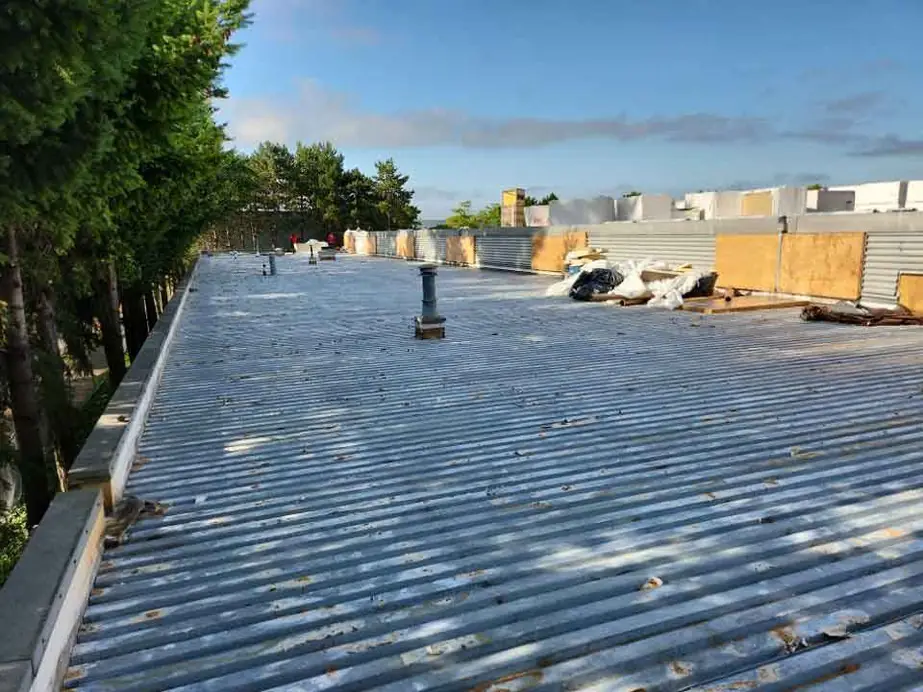
A tenant calls on Monday morning. There is water on the floor near the back wall, and it has not rained since Saturday. On a flat or low-slope roof, that delay is common. Water can sit, travel along the deck and surface somewhere that has nothing to do with the opening. For a property manager with a warehouse, an office building or a multi-unit property, the job is to catch the small signs before the tenant's phone call.
Ponding: water that stays
Puget Sound has a long wet season, so a low-slope roof spends many days a year wet. What matters is how quickly it drains. A puddle that is still there a day or two after the rain stops is worth writing down and photographing. Ponding can point to a clogged drain, a low spot in the deck, or insulation that has compressed over the years. It also keeps constant moisture and weight on the membrane and its seams.
Keep the drains and scuppers clear of needles, leaves and moss. In western Washington that is a seasonal chore, and the autumn leaf drop is the one that bites. A drain that clogs in November can turn the roof into a shallow pond by January.
Punctures and foot traffic
Most commercial roofs carry equipment, and every service call means someone walking the surface. A dropped tool, a ladder foot, a pipe bracket or a rooftop unit being moved can all puncture the membrane. The damage is often small and invisible from the ground.
Steve K. had a low-slope roof replaced by Pacific Pride and described a follow-up job in his own words: “They subsequently patched a puncture in the roof.” A good practice is to keep a simple log of who goes onto the roof and when, and to have someone look at the membrane after any rooftop work.
- Standing water a day or two after rain.
- Black staining or cracking along parapet walls and coping.
- Membrane lifting or pulling away at the wall edge.
- Soft or spongy spots underfoot.
- Blocked drains, scuppers and downspouts.
- Fresh patches that are already failing.
Parapet walls and coping
The parapet is where the roof meets the wall, and it is one of the most common failure points. The coping is the cap on top. When it cracks or its joints open, water gets into the wall and behind the membrane. Black staining on the face of the parapet, gaps at the coping joints, and a membrane that is torn or pulling away at the edge are all signs to flag.
Layered roofs and what is hiding underneath
Many older commercial roofs have been recovered more than once, with a new layer placed over the last. Each layer can hide water from the layer beneath it, and wet insulation can sit unnoticed for years. That is why a surface leak can be the smallest part of the problem.
Steve K. described what his project involved: “They removed two layers of built up and torch down, stripped down to the plywood, repaired the surface and installed a TPO Roof.” Taking a low-slope roof down to the deck is not always needed, but when a roof has failed in more than one place, it may be the only way to see what is really there. Pacific Pride's commercial process starts with a full on-site inspection and moisture detection, followed by a repair versus replacement evaluation.
Planning the work around the business
Roof work on an occupied building has to fit around the people inside it. Their commercial approach is a plan built around your operations, with minimal disruption, coordinating the work to keep your business running smoothly. That plan is worth asking about in detail: tenant hours, noise, access to the roof, where materials will be staged, where the dumpster goes, and which doors and parking areas stay open.
Pacific Pride handles installation, repairs and maintenance for offices, warehouses, retail buildings and multi-unit properties throughout Snohomish County, and also works with builders and contractors on new construction. Regular maintenance and small repairs, done before a leak appears, make a budget easier to plan.
If you manage a property with a low-slope roof, start with a walk-through after the next heavy rain and take photographs. Then call (425) 252-0444 to schedule a free roof estimate. For a roof you are worried about, the $349 Roof Report covers commercial properties and gives you an on-site visit, a leak and problem area review, a repair versus replacement evaluation and clear written recommendations to take to ownership.
Pacific Pride Roofing, (425) 252-0444
Call (425) 252-0444More articles
Repair or Replace? How a Roofer Decides on a Puget Sound Roof
A ceiling stain after the first October rain does not automatically mean a new roof, and it does not automatically mean a patch either.
Moss on Your Roof in the Pacific Northwest: What It Does and What to Do
A green roof is so common in western Washington that most people stop noticing it. Here is why it is worth a closer look.